

Guide · Home care
Refrigerator Care
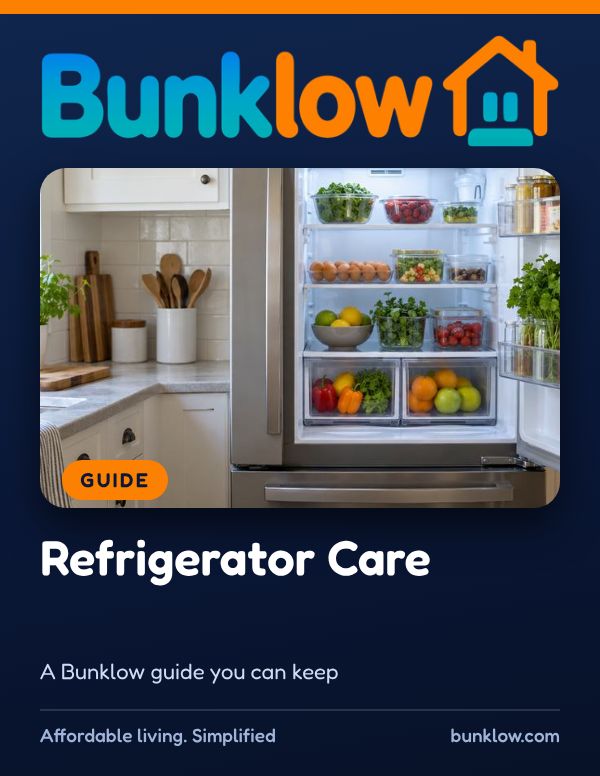
A friendly, practical guide to keeping food safe and the refrigerator running well, from the right temperatures and door seals to coils, ice makers, water lines and power outages.
Where to start
- Stopped cooling or leaking?
Keep the doors closed to hold the cold in. See if it stops cooling or leaks.
- Power out?
Keep the doors shut as much as you can. See when the power goes out.
- Everyday care?
Tick through the refrigerator checklist.
The short version
The refrigerator works around the clock to keep food safe, and it only asks for a little care.
Keep it at 40°F or below and the freezer at 0°F, and use a thermometer to be sure.
Close the door firmly, clean the gasket, and keep vents and coils clear so it can breathe.
If it stops cooling or leaks, keep the doors closed, check the power, and share it in writing right away.
Repair rules differ from place to place, so we’d gently encourage a quick look at the rules where your home is. If you ever have questions, we would love to help.
Four simple rules
- 1Keep it cold
The FDA recommends 40°F or below in the refrigerator and 0°F in the freezer.
- 2Keep the door sealed
Close the door firmly and keep the gasket clean so cold air stays in.
- 3Give it air
Dusty coils and blocked vents make the fridge work harder and wear out sooner.
- 4Watch for water
Share any puddle, drip or soft floor near the refrigerator right away.
Refrigerator checklist
From the guide’s own checklist. Tick each one as you go. Your ticks stay on this device. These are examples; your home may need others.
All done. I hope your food stays fresh and your kitchen stays easy.
For owners: before move in
From the guide’s own checklist. Tick each one as you go. Your ticks stay on this device. These are examples; your home may need others.
All done. About ten minutes at each turnover helps the refrigerator run cooler, quieter and longer.
If it stops cooling or leaks
- Take a breath. Keep the doors closed to hold the cold in.
- Check that it is plugged in, the breaker hasn’t tripped, and the temperature dial wasn’t bumped.
- If water is leaking, soak it up, and turn off the water supply valve to the ice maker if you can reach it safely.
- If the refrigerator stays warm for more than a few hours, move food to a cooler with ice.
- Take photos of the thermometer, any leak and the food affected.
- Share it in writing right away so it can be looked at quickly. You did exactly the right thing.
An open box of baking soda on a back shelf, replaced every few months, quietly soaks up odors.
When the power goes out
- Keep the doors shut as much as you can. FoodSafety.gov says a closed refrigerator keeps food safe for about four hours, a full freezer for about 48 hours, and a half full freezer for about 24 hours.
- After about four hours without power, many refrigerated foods, like meat, dairy and leftovers, should be thrown out. A thermometer helps you decide.
- If an outage is expected, a cooler and a few bags of ice on hand can save a lot of groceries.
When in doubt, throw it out.
Guides that go well with this one
Helpful resources
The guide points to these for details. Rules differ from place to place, so the official pages where your home is are the best guide.
Like it on paper?
The printable checklist for this guide is fillable, with a screen version and an ink saver print version. Keep it on your phone or pin it to the fridge.
How much do you remember?
4 quick questions from this guide, with a one line why for each. Totally optional, no sign in, and your answers are never saved.
Go deeper with The Perfect Seasonal Home Care Checklist Workbook
Simple, step by step checklists you can write in, one topic at a time, to help any home stay warm, safe and dry through every season.
Keep the full guide handy
The PDF has everything: everyday habits, what to do when something goes wrong, common myths, helpful resources and plenty of real-world tips. Print it, save it or share it with anyone who could use it.
Download the PDFTake it with you
- Bunklow Home Guide 040: Refrigerator Condenser Coil Vacuuming and Compressor Cooling CareA printable Bunklow guide to refrigerator condenser coil vacuuming and compressor cooling care: plain steps, how often to check, and when to call a pro.See it in the shop
- Bunklow Home Guide 042: Refrigerator In-Line Water Filter Cartridge Replacement and Line PurgingA printable guide to refrigerator in-line water filter cartridge replacement and line purging, in plain steps.See it in the shop
- Kitchen and Laundry Checklist PackThe Kitchen and Laundry checklists in one pack, fillable on screen or printable.See it in the shop
More guides


This guide shares general information to help you, and is not legal, food-safety or appliance repair advice. Please follow your owner’s manual and call a qualified technician for repairs. Bunklow does not inspect or repair appliances.