

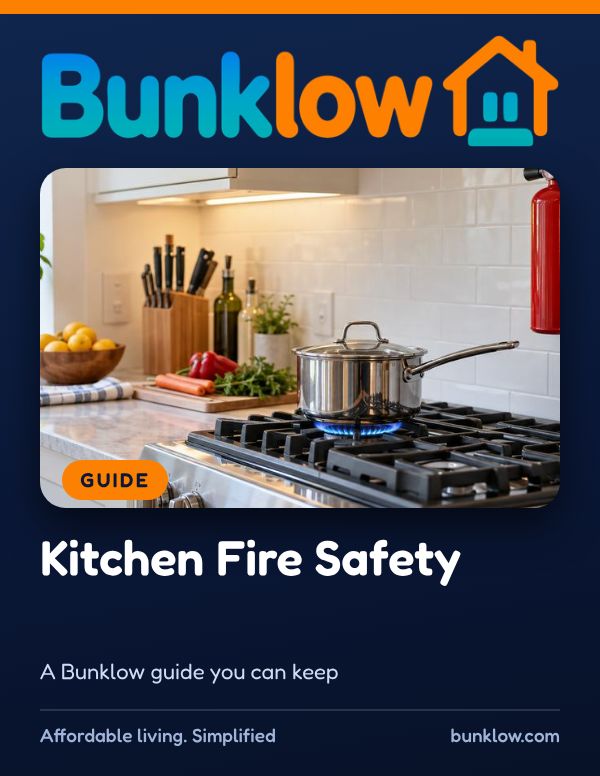
Guide · Safety and emergencies
Kitchen Fire Safety
A friendly, practical guide to cooking safely, handling a grease fire calmly, and knowing when to simply get out.
Where to start
- Pan on fire right now?
Turn off the burner and slide a lid or baking sheet over the pan. Never use water. If it is spreading, get out, close the door and call 911. See if a fire starts.
- Cooking tonight?
Tick through kitchen habits that help.
- Getting a kitchen ready for residents?
The short version
Cooking fires are among the most common home fires, and the leading cause is cooking left unattended. Stay with your pan, and turn the burner off if you leave the kitchen.
If a pan catches fire, turn off the heat and slide a lid or baking sheet over it. Never use water, and never carry a burning pan.
For an oven or microwave fire, turn it off and keep the door closed. If a fire is spreading or you’re unsure, get out, close the door and call 911.
Know where the fire extinguisher is and remember PASS: Pull, Aim, Squeeze, Sweep. Use it only on a small fire with a clear way out.
Fire safety rules differ from place to place, so we’d gently encourage a quick look at your local rules. If you ever have questions, we would love to help.
Four simple rules
- 1Stay with your pan
Stay in the kitchen while frying, grilling or broiling. If you need to leave, even briefly, turn the burner off.
- 2Never use water on grease
Water makes a grease fire explode and spread. Turn off the heat and cover the pan with a lid instead.
- 3Keep a lid within reach
A lid or baking sheet next to the stove is the fastest, safest way to smother a small pan fire.
- 4When in doubt, get out
If a fire is spreading or you feel unsure, get everyone outside, close the door behind you and call 911.
Kitchen habits that help
From the guide’s own habits. Tick each one as you go. Your ticks stay on this device. These are examples; your home may need others.
All done. Stay with your pan and enjoy the meal.
A few things to avoid
- Please don’t leave the stove on when you leave the kitchen, step outside or lie down, even for a moment.
- Please don’t ever pour water on a grease fire or try to carry a burning pan outside.
- Please don’t cook in loose, flowing sleeves, or when you are very sleepy.
- Please don’t store things in the oven or on the stovetop, where they can be forgotten when it is turned on.
Keep a lid that fits your frying pan on the counter right beside it every time you cook with oil. If anything flares up, you won’t have to search for it.
If a fire starts while cooking
- Stay calm. If the fire is small and in a pan, turn off the burner right away.
- Slide a lid or baking sheet over the pan to smother it, and leave it covered until fully cool.
- For an oven or microwave fire, turn it off and keep the door closed until the fire goes out.
- If the fire is spreading, or you are unsure, get everyone out, close the door behind you, and call 911 from outside.
- Never go back inside for belongings. Wait for the fire department to say it is safe.
- Once everyone is safe, share what happened in writing so the kitchen can be checked and anything damaged can be repaired.
Cooking oil usually starts to smoke before it can catch fire. If you see smoke, turn the heat down or off and move the pan off the burner.
Using an extinguisher: PASS
Stand back about six to eight feet, or follow the distance on the label.
- Pull the pin.
- Aim at the base of the fire.
- Squeeze the handle.
- Sweep side to side.
Use an extinguisher only on a small, contained fire, with everyone else out and a clear exit behind you. If it doesn’t go out quickly, leave and call 911.
Before anyone moves in
From the guide’s list for preparing the kitchen. Tick each one as you go. Your ticks stay on this device. These are examples; your home may need others.
All done. The kitchen is ready for safe cooking.
After a kitchen fire
- Make sure everyone is safe and cared for first. Kindness matters most in a stressful moment.
- Replace or recharge any extinguisher that was used, even partly.
- Have the stove, hood, outlets and nearby wiring checked before the kitchen is used again.
- Check and test nearby smoke alarms, since smoke can affect them.
- Keep photos, notes and invoices of the damage and repairs.
- Talk together, gently and without blame, about what happened and how to help prevent it next time.
Mount the extinguisher near the kitchen exit rather than right beside the stove. That way you can reach it while moving away from the fire, not toward it.
A few more helpful habits
- Thaw before you fry. Ice and water on frozen food can make hot oil splatter or boil over. Thaw and pat food dry before adding it to oil.
- If clothing catches fire. Stop, drop to the ground, cover your face with your hands, and roll until the fire is out. Then cool the burn with water and get help.
- Treating minor burns. Cool a minor burn under cool, not icy, running water for several minutes. For burns that are large, deep or on the face or hands, please seek medical care.
- Smoke alarms and cooking. If cooking sets off an alarm, open a window and fan the air rather than removing the battery. If it happens often, ask about moving the alarm.
Guides that go well with this one
Helpful resources
U.S. Fire Administration: Cooking Fire Safety and NFPA: Safety with Cooking Equipment. Your local fire department can help with questions about the rules where your home is.
Like it on paper?
The printable checklist for this guide is fillable, with a screen version and an ink saver print version. Keep it on your phone or pin it to the fridge.
How much do you remember?
4 quick questions from this guide, with a one line why for each. Totally optional, no sign in, and your answers are never saved.
Go deeper with The Perfect Seasonal Home Care Checklist Workbook
Simple, step by step checklists you can write in, one topic at a time, to help any home stay warm, safe and dry through every season.
Keep the full guide handy
The PDF has everything: everyday habits, what to do when something goes wrong, common myths, helpful resources and plenty of real-world tips. Print it, save it or share it with anyone who could use it.
Download the PDFTake it with you
- Bunklow Home Guide 020: Residential Fire Extinguisher Selection, Gauge Checks, and the PASS MethodA printable guide to residential fire extinguisher selection, gauge checks, and the pass method, in plain steps.See it in the shop
- Fire and Electrical Safety Checklist PackThe Fire and Electrical Safety checklists in one pack, fillable on screen or printable.See it in the shop
More guides

This guide shares general information to help you, and is not legal, medical or safety-code advice. In any emergency, please call 911. Bunklow does not inspect properties.