

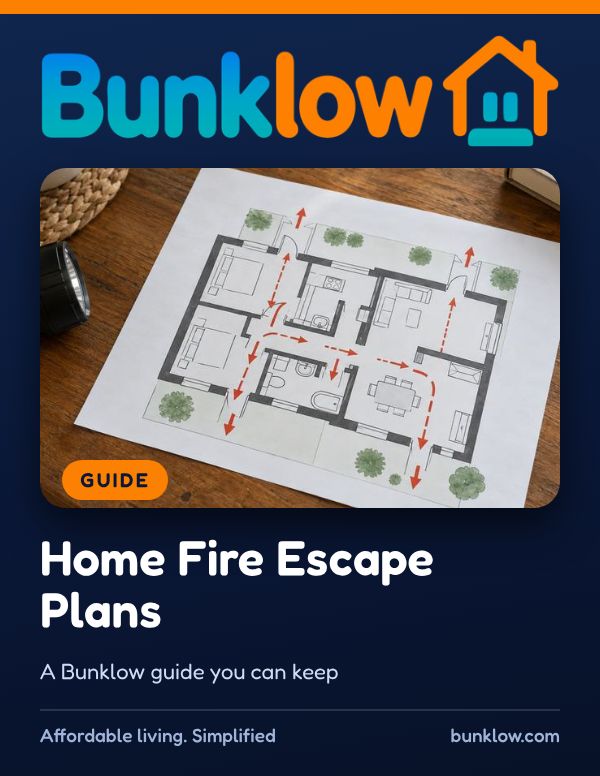
Guide · Safety and emergencies
Home Fire Escape Plans
A friendly, practical guide to making and practicing a home fire escape plan, with two ways out of every room, a meeting place and a plan for everyone in the home.
Where to start
- Smoke alarm sounding right now?
Get out, stay out, and call 911 from outside. See if the smoke alarm sounds.
- Making your plan?
Tick through steps for a strong plan. It takes about fifteen minutes.
- Getting exits ready for residents?
See keeping exits ready.
The short version
In a fire, there may be only a couple of minutes to get out, and a practiced plan turns panic into action.
Know two ways out of every room, choose a meeting place outside, and keep exits and windows clear.
Test smoke alarms monthly, sleep with doors closed, and plan who helps children, older adults and pets.
If the alarm sounds, get out, stay out, and call 911 from outside. Practice twice a year, once at night.
Fire safety rules differ from place to place, so we’d gently encourage a quick look at the rules where your home is. If you ever have questions, we would love to help.
Four simple rules
- 1Two ways out of every room
Know two exits from every room, usually a door and a window, and make sure both open easily.
- 2A meeting place outside
Choose one spot in front of the home, like a mailbox or tree, where everyone gathers.
- 3Get out, stay out
Never go back inside a burning home for belongings or pets. Tell firefighters instead.
- 4Practice twice a year
A plan only works if everyone has practiced it, day and night.
Steps for a strong plan
From the guide’s own plan steps. Tick each one as you go. Your ticks stay on this device. These are examples; your home may need others.
All done. Your plan is ready. Practice it twice a year, once at night.
If the smoke alarm sounds
- Get out right away. Leave everything behind.
- If there is smoke, get low and go under it to your exit.
- Feel a closed door with the back of your hand. If it’s hot, use your second way out.
- Close doors behind you as you leave to slow the fire.
- Go straight to your meeting place, and call 911 from outside.
- Tell firefighters if anyone, including a pet, is still inside. You did exactly the right thing.
Practice crawling low to the door with your eyes closed once. In real smoke, it is very hard to see, and knowing the way by feel helps.
Please never do these
- Please don’t go back inside for belongings, phones or pets.
- Please don’t hide from a fire. Children especially should practice getting out and staying out.
- Please don’t use an elevator during a fire.
- Please don’t block windows with furniture, air conditioners or bars that can’t be opened from inside.
Close before you doze. Sleeping with bedroom doors closed can slow the spread of smoke and fire and buy precious time.
Planning for everyone
Plan who will help young children, older adults and anyone with a disability, and keep glasses, mobility aids and hearing aids by the bed.
For upper floors, know where the stairs are, and if a window is your second way out, ask about escape ladders. Store a folding escape ladder near the window and practice setting it up.
For anyone with hearing loss, smoke alarms with strobe lights or bed shakers help make sure everyone gets the warning.
Plan for pets, but never go back in for them.
For more, see Ready.gov: Home Fires and U.S. Fire Administration: Smoke Alarms.
Keeping exits ready
From the guide’s list for supporting safe exits. Tick each one as you go. Your ticks stay on this device. These are examples; your home may need others.
All done. Every exit is ready for the people who may need it.
When an exit concern is shared
- Treat a window or door that won’t open as urgent. It is an exit.
- Fix broken locks, latches and stuck windows promptly.
- Respond to requests for strobe or bed shaker alarms for residents with hearing loss with care.
- Remind residents kindly to keep exits clear in shared buildings.
- Write down what was reported, what was done and when.
Open every bedroom window during each turnover. A window painted shut or stuck is a lost exit, and it is easy to fix before someone needs it.
Guides that go well with this one
Like it on paper?
The printable checklist for this guide is fillable, with a screen version and an ink saver print version. Keep it on your phone or pin it to the fridge.
How much do you remember?
4 quick questions from this guide, with a one line why for each. Totally optional, no sign in, and your answers are never saved.
Go deeper with The Perfect Seasonal Home Care Checklist Workbook
Simple, step by step checklists you can write in, one topic at a time, to help any home stay warm, safe and dry through every season.
Keep the full guide handy
The PDF has everything: everyday habits, what to do when something goes wrong, common myths, helpful resources and plenty of real-world tips. Print it, save it or share it with anyone who could use it.
Download the PDFTake it with you
- Bunklow Home Guide 018: Residential Smoke Alarms, Sensor Types, and NFPA 72 Installation StandardsA printable guide to residential smoke alarms, sensor types, and nfpa 72 installation standards, in plain steps.See it in the shop
- Bunklow Home Guide 020: Residential Fire Extinguisher Selection, Gauge Checks, and the PASS MethodA printable guide to residential fire extinguisher selection, gauge checks, and the pass method, in plain steps.See it in the shop
- Fire and Electrical Safety Checklist PackThe Fire and Electrical Safety checklists in one pack, fillable on screen or printable.See it in the shop
More guides
This guide shares general information to help you, and is not legal or safety-code advice. Always follow the instructions of your local fire department. Bunklow does not inspect properties.