

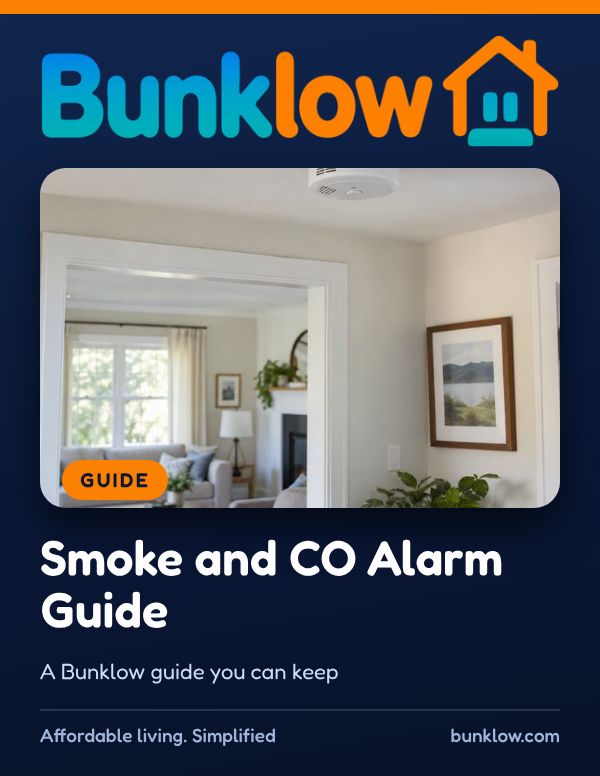
Guide · Safety and emergencies
Smoke and CO Alarm Guide
A friendly, practical guide to the small devices that protect everyone in the home, and the simple habits that keep them working.
Where to start
- An alarm is sounding?
Smoke: get everyone out and call 911 from outside. Carbon monoxide: go outside to fresh air right away, then call 911. See if an alarm sounds.
- An alarm is chirping?
A chirp means the battery is low or the alarm needs attention. Please share it right away.
- Just moved in?
Test every alarm together and write down the date on each label. Then tick through simple habits that help.
The short version
Working alarms protect everyone in the home, and keeping them working takes only a few minutes a month.
Test every smoke and CO alarm monthly. Check the date on each label: smoke alarms generally need replacing about every 10 years, and CO alarms often sooner.
Smoke alarms belong in every bedroom, outside sleeping areas and on every level. CO alarms belong outside sleeping areas and on every level.
If a smoke alarm sounds, get out and stay out. If a CO alarm sounds, go outside to fresh air first, then call 911.
Rules about alarms vary from place to place, so we’d gently encourage a quick look at the rules where your home is. If you ever have questions, we would love to help.
Four simple rules
- 1Test every alarm monthly
Press and hold the test button until it sounds. It takes seconds, and it is the only way to know it works.
- 2Check the date on the label
Smoke alarms generally need replacing about every 10 years. CO alarms often have a shorter life, so follow the date and instructions on each one.
- 3Never disable an alarm
If an alarm is bothering you, please share it right away so it can be cleaned, moved or replaced, rather than taking it down.
- 4If CO sounds, get outside
Leave the home for fresh air first, then call 911. Never stay inside to look for the cause.
Simple habits that help
From the guide’s own checklist. Tick each one as you go. Your ticks stay on this device. These are examples; your home may need others.
All done. Working alarms are one of the simplest, kindest things we can make sure of together.
If an alarm sounds
- Smoke alarm: get everyone out, stay low under smoke, and close doors behind you if you can.
- Once outside, call 911, and never go back inside for belongings or pets.
- Carbon monoxide alarm: go outside to fresh air right away, then call 911.
- Count everyone at a meeting spot outside the home, like a mailbox or a neighbor’s tree.
- Let the fire department or gas utility say when it is safe to go back in.
- When everyone is safe, let whoever handles repairs know in writing what happened.
You did exactly the right thing.
A few things to avoid
- Please don’t remove batteries or take an alarm down, even after a cooking false alarm.
- Please don’t paint over an alarm or cover it with stickers or decorations.
- Please don’t use a stove, oven or grill to heat the home. It can create dangerous carbon monoxide.
- Please never run a car, generator or gas tool inside a garage or home, even with the door open.
For owners: before anyone moves in
- Make sure there is a working smoke alarm in every bedroom, outside each sleeping area and on every level of the home.
- Make sure there are CO alarms outside sleeping areas and on every level, especially in homes with gas appliances, a fireplace or an attached garage.
- Test every alarm and write down the date printed on each label during the move in walk.
- Replace any alarm past its date, and put in fresh batteries where the alarm uses them.
- Show everyone how to test the alarms and how to tell the sounds apart.
- Leave the instruction sheets or model numbers in a kitchen drawer for easy reference.
Guides that go well with this one
How much do you remember?
4 quick questions from this guide, with a one line why for each. Totally optional, no sign in, and your answers are never saved.
Go deeper with The Perfect Seasonal Home Care Checklist Workbook
Simple, step by step checklists you can write in, one topic at a time, to help any home stay warm, safe and dry through every season.
Keep the full guide handy
The PDF has everything: everyday habits, what to do when something goes wrong, common myths, helpful resources and plenty of real-world tips. Print it, save it or share it with anyone who could use it.
Download the PDFTake it with you
- Bunklow Home Guide 018: Residential Smoke Alarms, Sensor Types, and NFPA 72 Installation StandardsA printable guide to residential smoke alarms, sensor types, and nfpa 72 installation standards, in plain steps.See it in the shop
- Bunklow Home Guide 019: Carbon Monoxide (CO) Alarms, Sensor Lifespans, and Placement RulesA printable Bunklow guide to carbon monoxide (co) alarms, sensor lifespans, and placement rules: plain steps, how often to check, and when to call a pro.See it in the shop
- Fire and Electrical Safety Checklist PackThe Fire and Electrical Safety checklists in one pack, fillable on screen or printable.See it in the shop
More guides
This guide shares general information to help you, and is not legal or safety-code advice. Bunklow does not inspect properties.