

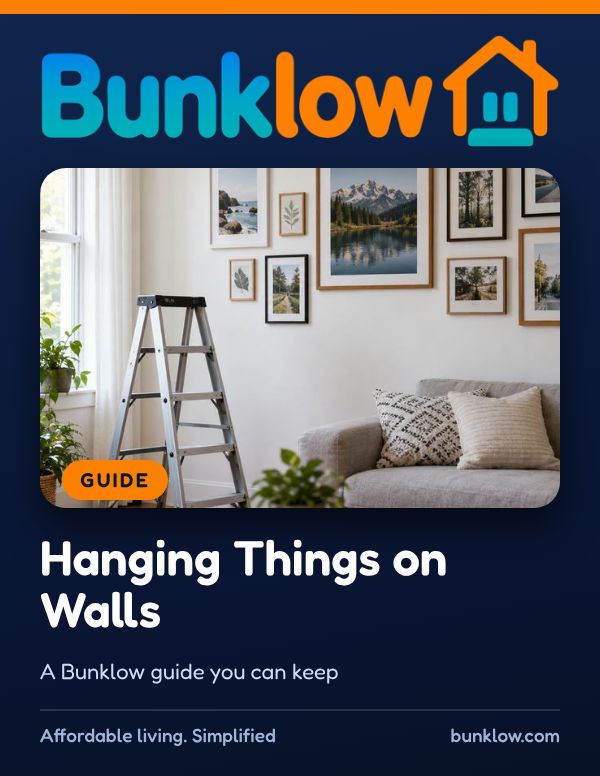
Guide · Home care
Hanging Things on Walls
A friendly, practical guide to hanging pictures, shelves and TVs safely, choosing the right anchor, and leaving walls in great shape.
Where to start
- Hit a wire or pipe?
Stop drilling right away and step back. See if you hit a wire or pipe.
- About to drill?
Ask first in writing, then run through the hanging things checklist.
- Not sure which hook?
The short version
Hanging things well keeps walls in good shape and keeps everyone safe. A little planning goes a long way.
Ask in writing before drilling or mounting, check the weight rating on every hook and anchor, and fasten heavy items into studs.
Wires and pipes hide in walls. Stay clear of areas above and below outlets, switches and fixtures, and anchor tall furniture and TVs so they can’t tip.
If you hit a wire or pipe, stop, make it safe, and share it right away. Repairs inside walls are a job for a licensed professional.
Rules about alterations and normal wear differ from place to place, so we’d gently encourage a quick look at your local rules. If you ever have questions, we would love to help.
Four simple rules
- 1Ask first, in writing
A quick message before drilling or mounting avoids surprises and keeps everyone on the same page.
- 2Match the hardware to the weight
Every hook, anchor and mount has a weight rating. Choose one rated well above what you are hanging.
- 3Heavy things go into studs
TVs, shelves, mirrors and cabinets are safest when fastened into the wood framing behind the wall.
- 4Know what is behind the wall
Wires and pipes hide inside walls. Staying clear of the areas above and below outlets, switches and fixtures helps avoid them.
Hanging things checklist
From the guide’s own checklist. Tick each one as you go. Your ticks stay on this device. These are examples; your home may need others.
All done. Your favorite things are on the wall and your walls are in great shape.
Choosing the right hardware
These are common examples, not a complete list. When in doubt, check the package and ask.
- Light pictures usually do well on a picture hook or a small nail.
- Medium items, like small shelves or light mirrors, usually need a wall anchor rated for the weight.
- Heavy items, like TVs, large mirrors and loaded shelves, are safest fastened into studs with screws, using hardware rated well above their weight.
Tall or top heavy furniture like dressers and bookcases can tip over, and TVs can fall. Anti tip kits connect furniture to the wall. The U.S. Consumer Product Safety Commission’s Anchor It program explains how. Always ask before anchoring into the wall.
If you hit a wire or pipe
- Stop drilling right away and step back. If you hit a pipe and water is spraying, please don’t pull the bit or nail out.
- If you hit a wire, see sparks or smell burning, turn off the breaker for that area if you can do so safely, and keep everyone away.
- If you hit a water pipe, turn off the main water valve, protect belongings and soak up water with towels.
- If there is fire, smoke, heavy sparking or a lot of water, leave and call 911.
- Take photos and share what happened right away, even if everything seems fine now.
- Please don’t try to repair wiring or plumbing inside the wall. A licensed electrician or plumber should take a look.
Take a breath. Stopping and sharing it right away is exactly the right thing.
A few things to avoid
- Please don’t drill or nail directly above or below outlets, switches or light fixtures, where wires often run.
- Please don’t hang heavy items from a single nail or from drywall alone without a rated anchor.
- Please don’t mount anything on ceilings, cabinets, doors or tile without asking first.
- Please don’t drill or sand walls in a home built before 1978 without asking first, since older paint may contain lead.
- Please don’t use a ladder to reach high spots. Ceiling hooks, spots above doorways and anything up high are a job for the owner or a qualified installer.
Before drilling, picture a line running straight up and down from every outlet and switch. Wires often follow those lines, so choose a spot off to one side.
Hanging art that looks right
- A common guide is to place the center of a picture about 57 to 60 inches from the floor. It looks balanced in most rooms and keeps holes to a minimum.
- Before making a single hole, trace your frames onto paper, cut them out and tape them to the wall to try different layouts.
Guides that go well with this one
Like it on paper?
The printable checklist for this guide is fillable, with a screen version and an ink saver print version. Keep it on your phone or pin it to the fridge.
How much do you remember?
4 quick questions from this guide, with a one line why for each. Totally optional, no sign in, and your answers are never saved.
Go deeper with The Perfect Toolkit
Can I fix this, or should I call someone? The Perfect Toolkit is a calm, plain book for residents and owners on building a basic home toolkit, using it safely for small everyday fixes, and knowing exactly when to stop and call the owner or a pro.
Keep the full guide handy
The PDF has everything: everyday habits, what to do when something goes wrong, common myths, helpful resources and plenty of real-world tips. Print it, save it or share it with anyone who could use it.
Download the PDFTake it with you
- Bunklow Home Guide 064: Interior Drywall Picture Nail Hole Spackling and SandingA printable Bunklow guide to interior drywall picture nail hole spackling and sanding: plain steps, how often to check, and when to call a pro.See it in the shop
- Floors, Walls and Finishes Checklist PackThe Floors, Walls and Finishes checklists in one pack, fillable on screen or printable.See it in the shop
More guides


This guide shares general information to help you, and is not legal or safety-code advice. Always follow the instructions that come with your hardware and mounts. Bunklow does not inspect properties or decide deposits.