

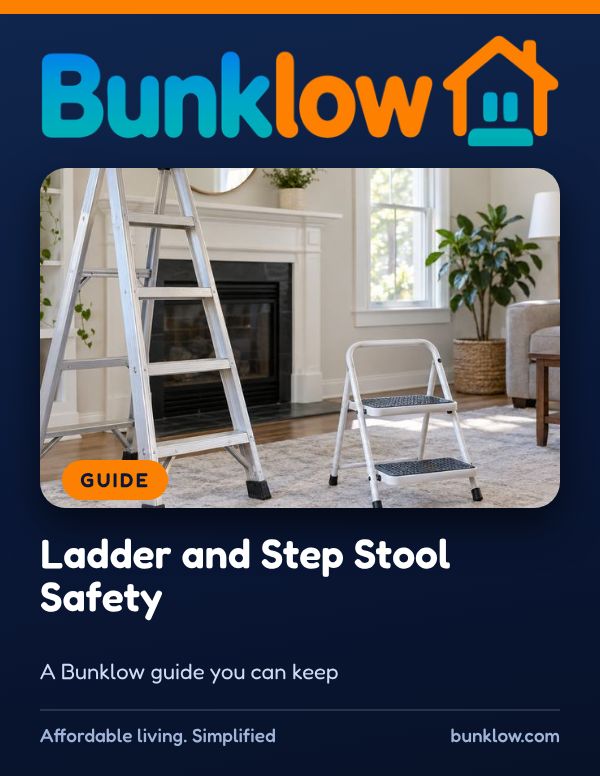
Guide · Safety and emergencies
Ladder and Step Stool Safety
A friendly, practical guide to choosing and using ladders and step stools safely, from setting them up right to knowing when to call a professional.
Where to start
- Someone just fell?
Stay calm and don’t move them if they may have hurt their head, neck or back. Call 911 if they seem seriously hurt. See if someone falls.
- About to climb?
Tick through safe climbing habits and check before you climb.
- Owner with a high job to do?
The short version
Falls from even a few feet can cause serious injuries, and a few simple habits keep everyone safe when reaching high places.
Use a step stool or ladder made for the job, never a chair, and look it over before each use.
Set it on firm, level ground, keep three points of contact, never stand on the top step and don’t overreach.
Look up for power lines outdoors, and leave roofs and high gutters to the professionals.
Rules about maintenance at height differ from place to place, so we’d gently encourage a quick look at the rules where your home is. If you ever have questions, we would love to help.
Four simple rules
- 1The right tool, never a chair
Use a sturdy step stool or ladder made for the job. Chairs, boxes and buckets are not ladders.
- 2Three points of contact
Keep two hands and a foot, or two feet and a hand, on the ladder at all times.
- 3Don’t overreach
Keep your belt buckle between the rails. If you can’t reach, climb down and move the ladder.
- 4Stay away from power lines
Look up before raising a ladder outdoors, and keep well clear of overhead wires.
Safe climbing habits
From the guide’s own habits. Tick each one as you go. Your ticks stay on this device. These are examples; your home may need others.
All done. Climb steady and come back down safely.
Please never do these
- Please don’t stand on chairs, tables, buckets or boxes to reach high places.
- Please don’t stand on the top step or top cap of a stepladder.
- Please don’t use a metal ladder near electrical wires or work outdoors in wind or rain.
- Please don’t climb onto a roof. Roof work belongs to trained professionals.
Stand with your toes touching the ladder’s feet and reach your arms straight out. Your palms should just touch a rung. It is a quick way to check the angle.
Check before you climb
Look for cracks, bends, loose rungs, missing rubber feet and locks that don’t catch. If anything looks wrong, don’t use it.
Setting up an extension ladder. For every four feet of height up to where the ladder rests, set the base about one foot out from the wall. When climbing onto a surface, the ladder should extend about three feet above the edge, and the base must be secure on firm, level ground.
Before you climb, move everything you need within easy reach and put tools in a bag or pocket. Empty hands mean steadier climbing.
If someone falls
- Stay calm and don’t move them if they may have hurt their head, neck or back.
- Call 911 if they are unconscious, can’t move, are bleeding heavily or seem seriously hurt.
- Keep them still and warm, and stay with them until help arrives.
- If they seem fine, encourage them to rest and to see a doctor, especially after hitting their head.
- Once everyone is safe, take photos of the ladder and the area where the fall happened.
- Share what happened so anything unsafe can be fixed. You did exactly the right thing.
Before work at height begins
From the guide’s list for jobs at height. Tick each one as you go. Your ticks stay on this device. These are examples; your home may need others.
All done. High jobs are set up to be safe.
When a high job comes up
- When a high job is requested, offer to handle it or send a professional rather than asking residents to climb.
- Use insured professionals with the right equipment for any work at height outdoors.
- Replace bulbs in tall fixtures with long life LEDs to reduce how often anyone has to climb.
- Follow up kindly after any fall to see how the person is doing and what can be made safer.
- Write down what was reported, what was done and when.
Keep a good step stool with a handrail in every home you care for. It costs little and prevents the chair climbing that leads to so many falls.
Guides that go well with this one
Helpful resources
CDC: Older Adult Falls and Electrical Safety Foundation International: Home Electrical Safety Checklist. Please follow the ladder maker’s instructions, and read the sticker on the side of the ladder for how much weight it can safely hold, including you and your tools.
Like it on paper?
The printable checklist for this guide is fillable, with a screen version and an ink saver print version. Keep it on your phone or pin it to the fridge.
How much do you remember?
4 quick questions from this guide, with a one line why for each. Totally optional, no sign in, and your answers are never saved.
Go deeper with The Perfect Toolkit
A calm, plain guide for residents and owners to building a basic home toolkit, using it safely for small everyday fixes, and knowing exactly when to stop and call the owner or a pro.
Keep the full guide handy
The PDF has everything: everyday habits, what to do when something goes wrong, common myths, helpful resources and plenty of real-world tips. Print it, save it or share it with anyone who could use it.
Download the PDFMore guides



This guide shares general information to help you, and is not legal, medical or safety-code advice. Please follow the ladder maker’s instructions and use professionals for work at height. Bunklow does not inspect properties or make repairs.