

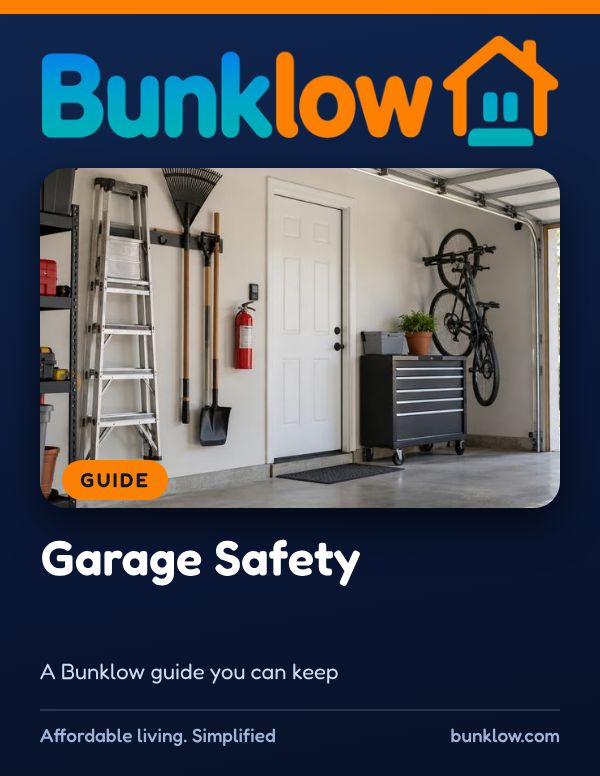
Guide · Home care
Garage Safety
A friendly, practical guide to garage doors, safe storage, chemicals, carbon monoxide and fire safety, for everyone who uses the garage.
Where to start
- Feeling dizzy or sick after an engine ran?
Get everyone into fresh air and call 911. See if something goes wrong.
- Not sure the door is safe?
Try the monthly door test.
- Want a safer garage?
Work through the garage safety checklist.
The short version
The garage holds a heavy moving door, fuel, chemicals and vehicles, so a few simple habits keep it safe for everyone.
Test the garage door’s safety reverse about once a month, keep the sensors clear, and leave springs and cables to a trained technician.
Never run a vehicle or generator in an attached garage, even with the door open. Carbon monoxide can seep into the home.
Store fuel and chemicals tightly closed, away from heat and flames and out of children’s reach, and charge batteries where you can watch them.
Rules about garages and storage differ from place to place, so we’d gently encourage a quick look at the rules where your home is. If you ever have questions, we would love to help.
Four simple rules
- 1Test the door every month
The door should stop and reverse when it touches something or when the safety beam is blocked.
- 2Never run a vehicle inside
Even with the door open, exhaust can build up carbon monoxide and seep into the home.
- 3Fuel and chemicals stay put
Keep them in original or approved containers, closed tight, and away from heat, flames and children.
- 4Springs and cables are for pros
Garage door springs hold enormous tension. Repairs belong to a trained technician.
Garage safety checklist
From the guide’s own checklist. Tick each one as you go. Your ticks stay on this device. These are examples; your home may need others.
All done. Your garage is a safe, useful space for everyone.
The monthly door test
- Lay a roll of paper towels flat in the door’s path. When the closing door touches it, the door should stop and go back up.
- Close the door and wave a broom handle through the beam between the two sensors near the floor. The door should stop and reverse again.
- Wipe the little sensor lenses gently now and then. Both little lights should be steady.
- Follow the opener’s own instructions for the test.
Some signs the door needs service: it doesn’t reverse, moves jerkily, grinds or bangs, or sags on one side. Frayed cables, a gap in a spring, loose brackets or a blinking sensor light are also worth a technician’s look. These are examples, not a complete list.
If something goes wrong
- If the door is stuck partway or a spring has snapped, keep everyone out from under it.
- If anyone feels headachy, dizzy, weak, sick or confused after a vehicle or engine has run, get everyone into fresh air and call 911.
- If you smell gasoline or gas, don’t flip switches or start anything. Get outside and call for help from there.
- For a fire, get everyone out, close the door behind you if you can, and call 911 from outside.
- If the power is out and you need the door, pull the manual release only when the door is fully closed.
- Once it is safe, take photos and share what happened in writing right away.
Take a breath. You did exactly the right thing.
A few things to avoid
- Please don’t run a car, generator or gas powered tool in an attached garage, even with the door open.
- Please don’t let children play with the remote or run under a moving door.
- Please don’t store gasoline or propane near a water heater, furnace, dryer or other flame or spark. Gasoline vapors are heavier than air and can travel along the floor to a pilot light.
- Please don’t try to adjust or repair springs, cables or brackets. They are under very high tension.
Guides that go well with this one
Like it on paper?
The printable checklist for this guide is fillable, with a screen version and an ink saver print version. Keep it on your phone or pin it to the fridge.
How much do you remember?
4 quick questions from this guide, with a one line why for each. Totally optional, no sign in, and your answers are never saved.
Go deeper with The Perfect Seasonal Home Care Checklist Workbook
Simple, step by step checklists you can write in, one topic at a time, to help any home stay warm, safe and dry through every season.
Keep the full guide handy
The PDF has everything: everyday habits, what to do when something goes wrong, common myths, helpful resources and plenty of real-world tips. Print it, save it or share it with anyone who could use it.
Download the PDFMore guides
This guide shares general information to help you, and is not legal, medical or safety-code advice. Garage door repairs should be done by a trained technician. Bunklow does not inspect properties or make repairs.