

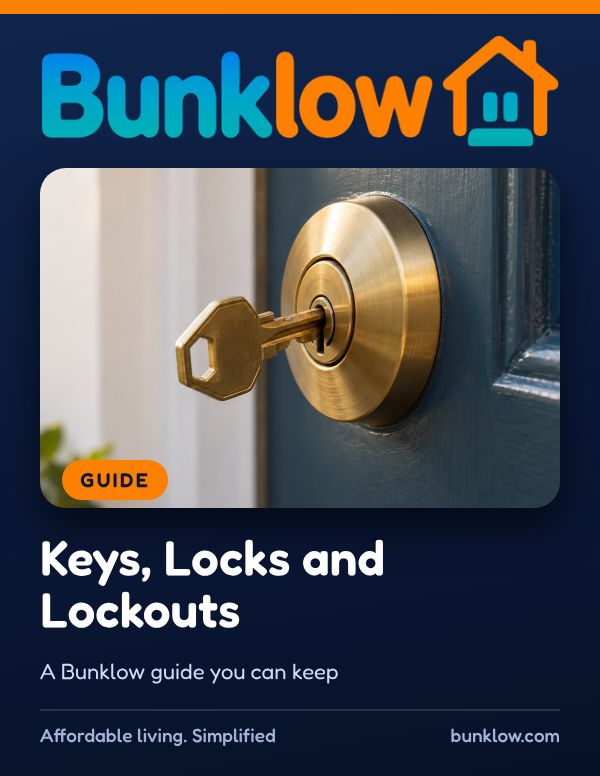
Guide · Renting and leases
Keys, Locks and Lockouts
A friendly, practical guide to keeping keys safe, handling lock changes, and getting back inside calmly when you’re locked out.
Where to start
- Locked out right now?
Take a breath. If you are in danger, or a child, pet or medical need is inside, call 911. Then see if you’re locked out.
- Just moved in?
Count and test every key, then tick through simple habits that help.
- Getting a home ready for new residents?
The short version
Keeping keys safe is mostly simple habits: know every key and code, never hide a key outside, and keep a spare with someone you trust.
Lock changes and key copies should be agreed on in writing. Rekeying between residents helps make sure only the people living there have working keys.
If you are locked out, stay safe, check for a roommate or spare first, then reach out to the owner or manager before calling a locksmith.
When you do call a locksmith, choose a local business, ask for the total cost up front, and expect to show ID. Remember garage remotes and keypad codes are keys too.
Lock rules differ from place to place, so we’d gently encourage a quick look at your local rules. If you ever have questions, we would love to help.
Four simple rules
- 1Know every key
Keep a simple list of every key, fob, remote and code for the home, and who has each one.
- 2Never hide a key outside
Mats, planters and ledges are the first places anyone looks. A trusted neighbor or a lockbox is much safer.
- 3Ask before changing locks
Lock changes and key copies should be agreed on in writing, so everyone who needs access still has it.
- 4Have a lockout plan
Know who to call, where a spare is, and how to find a trustworthy locksmith before you ever need one.
Simple habits that help
From the guide’s own habits. Tick each one as you go. Your ticks stay on this device. These are examples; your home may need others.
All done. Your keys are counted and your lockout plan is ready.
A few things to avoid
- Please don’t hide a key under a mat, in a planter, on a ledge or in the mailbox.
- Please don’t change or add locks without written permission from the owner.
- Please don’t put your address or unit number on your key ring.
- Please don’t climb through windows or force a door. It is easy to get hurt or cause damage.
Take a quick photo of every key, fob and remote laid out on the counter on move in day. At move out, you’ll know exactly what to return.
If you’re locked out
- Take a breath and stay safe. If you are in danger, or a child, pet or medical need is inside, call 911.
- Check the easy options first: another unlocked door, a roommate, or the person holding your spare.
- Reach out to the owner or property manager. Many have a spare key or a lockout plan.
- If you call a locksmith, choose one with a local address and good reviews, and ask for the total cost before they come.
- When the locksmith arrives, expect to show ID with your address, and ask to see their identification. Ask for an itemized receipt.
- Afterward, share what happened in writing, and replace a lost key or rekey the lock if the key may be in the wrong hands.
Save the owner’s or manager’s after hours number and a trusted locksmith’s number in your phone today. A lockout is much calmer with a plan already in your pocket.
Before anyone moves in
From the guide’s list for managing keys and locks. Tick each one as you go. Your ticks stay on this device. These are examples; your home may need others.
All done. Only the new household has working keys.
When keys go missing
- Respond quickly and calmly to lockouts and lost key reports. Safety comes first.
- Confirm identity before opening a door or handing over a key, every time.
- Rekey promptly when a key is lost or stolen, or when a resident asks with a safety concern.
- Keep a written log of every key issued, returned, copied or replaced.
- Store spare keys securely, coded rather than labeled with addresses.
- Give notice before entering, as the lease and local rules require, except in a true emergency.
Rekeying is often simpler and less costly than replacing a whole lock. A fresh set of keys for every new household is one of the kindest safety habits there is.
A few more helpful habits
- Smart locks and keypads. Change codes when anyone moves out or a guest no longer needs access, and use codes that aren’t easy to guess, like birthdays or 1234.
- Keep keys anonymous. Never put an address, unit number or name on a key ring. If keys are lost, they can’t lead anyone to your door.
- The trusted spare. Leave one spare key with a trusted friend or neighbor who lives nearby. It is the fastest, least costly lockout plan there is.
Guides that go well with this one
Helpful resources
National Crime Prevention Council: Home and Neighborhood Safety and California Department of Consumer Affairs: Consumer Tips for Hiring a Locksmith. Rules about locks differ from place to place, so a quick look at the rules where your home is goes a long way.
How much do you remember?
4 quick questions from this guide, with a one line why for each. Totally optional, no sign in, and your answers are never saved.
Go deeper with The Perfect Move-In Checklist Workbook
Simple, step by step checklists you can write in for moving in: the move in walk, moving day, your first week, utilities, keys and more.
Keep the full guide handy
The PDF has everything: everyday habits, what to do when something goes wrong, common myths, helpful resources and plenty of real-world tips. Print it, save it or share it with anyone who could use it.
Download the PDFTake it with you
- Bunklow Home Guide 120: Duplicate Key Cut Testing, Burr Removal, and Cylinder Smoothness ChecksA printable guide to duplicate key cut testing, burr removal, and cylinder smoothness checks, in plain steps.See it in the shop
- Bunklow Home Guide 118: Exterior Deadbolt Latch Throw Depth and Jam Strike Plate AlignmentA printable Bunklow guide to exterior deadbolt latch throw depth and jam strike plate alignment: plain steps, how often to check, and when to call a pro.See it in the shop
More guides
This guide shares general information to help you, and is not legal or safety advice. Bunklow does not provide lockout or locksmith services.